
Schengen Information System
What is SIS and how does it work?
The Schengen Information System (SIS) is the most widely used and largest information sharing system for security and border management in Europe. As there are no internal borders between Schengen countries in Europe, SIS compensates for border controls and is the most successful cooperation tool for border, immigration, police, customs and judicial authorities in the EU and the Schengen associated countries.
An alert entered in SIS by one country becomes available in real time in all other countries that use SIS, so that competent authorities across the EU can find the alert.
Technically, SIS consists of the following components:
- a central system
- national SIS systems in all the countries using SIS
- a network between the systems
Each country that uses SIS is responsible for setting up, operating and maintaining its national system and structures. The European Commission is responsible for general supervision, evaluating the system, and adopting implementing and delegated acts on how the SIS and SIRENE work. The EU Agency for large-scale IT systems (eu-LISA) is responsible for the operational management of the central system and the network.
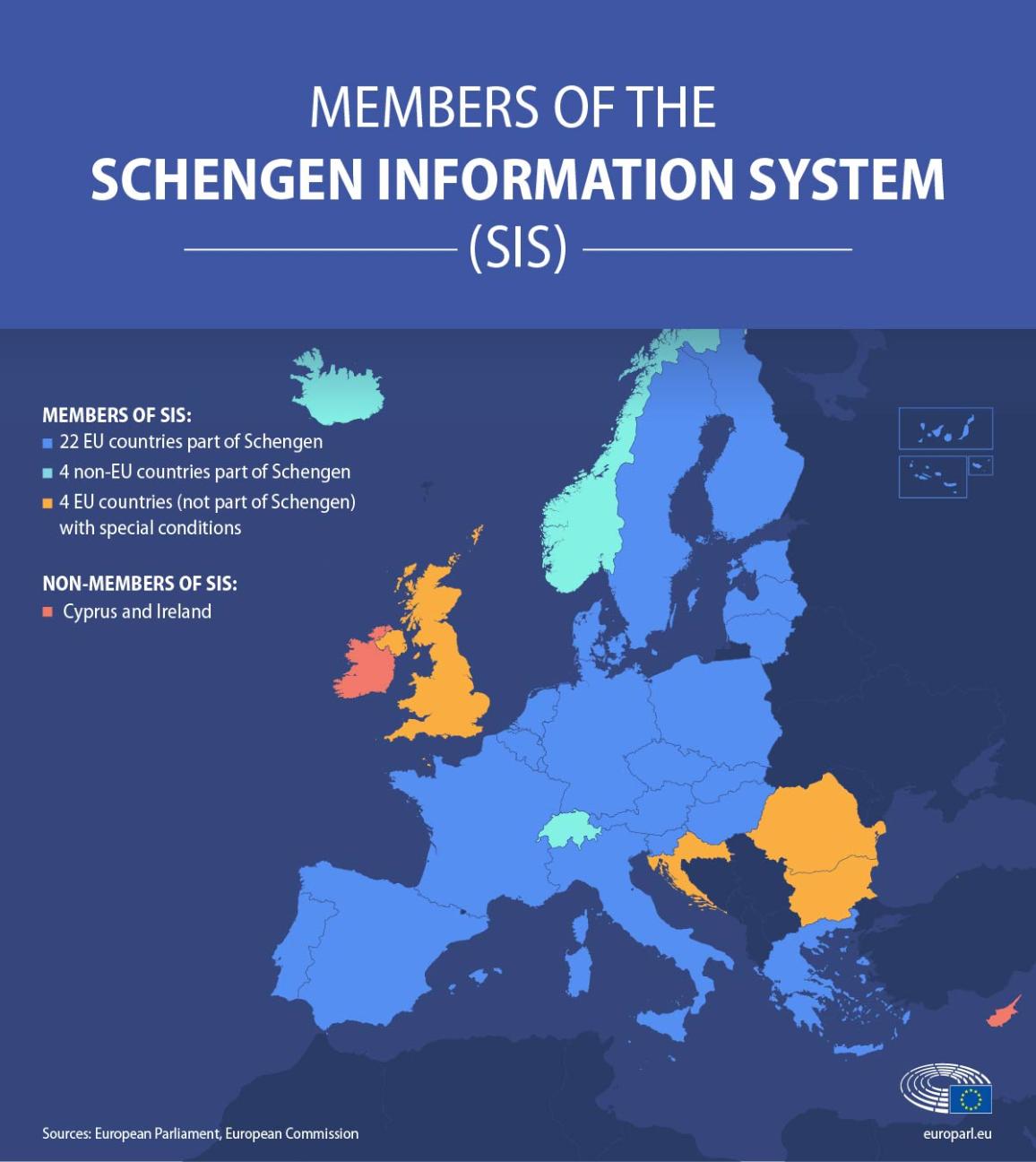
Countries using SIS
SIS is operational in most EU countries and the Schengen associated countries (Switzerland, Norway, Liechtenstein and Iceland).
Functionalities of SIS, as of 2023
Sharing information
New categories of alerts and more data are shared through SIS, ensuring that more complete and more reliable information is available to the authorities in countries that use SIS.
Biometrics
From March 2023, SIS contains the following types of biometrics to confirm and verify the identity of people registered in the system:
- photographs
- palm prints
- fingerprints
- fingermarks
- palmmarks
- DNA records (only in relation to missing persons)
Fingerprints, palm prints, fingermarks and palm marks are used for biometric searches through the automated fingerprint identification system in SIS.
SIS does not yet use photograph and facial image recognition technology. The Commission must provide a report on the availability, readiness and reliability of such technology before this can be put in place. The European Parliament will be consulted on the report. Once this technology is put in place in SIS, countries will be able to use these tools at regular border crossing points. After that, the Commission may adopt delegated acts determining other circumstances in which photographs and facial images may be used to identify persons.
Counter-terrorism
More information is being shared on people and objects involved in terrorism-related activities, allowing national authorities to better pursue and prevent serious crimes and terrorism.
Since March 2021, countries have shared search “matches” on SIS alerts related to terrorist offenceswith Europol. Europol exchanges supplementary information with countries on SIS alerts related to terrorist offences through the SIRENE Bureaux.
Vulnerable persons
Competent authorities can issue alerts on missing persons that include additional data. They can also enter preventive alerts in the system to protect certain categories of vulnerable persons (children at risk of abduction or potential victims of terrorism, trafficking in human beings, gender-based violence, or armed conflict/hostilities).
Irregular migration
Return decisions are part of the information shared in the system to improve the effective enforcement of these decisions. Countries must enter alerts for refusal of entry or stay on people found to be staying in the EU illegally who are subject to entry bans issued in line with the Returns Directive.
Cooperation between registration authorities extended to boat, aircraft and firearms registration
National services responsible for the registration of boats, aircraft and firearms may consult SIS in order to check the legal status of objects presented to them for registration.
- Boat registration services only have access to SIS alerts on boats and boat engines.
- Aircraft registration services only have access to alerts on aircraft and aircraft engines.
- Firearms registration services only have access to alerts for arrest for surrender or extradition, alerts for discreet, inquiry and specific checks and alerts on firearms for seizure or use as evidence.
Enhanced access for EU Agencies
Europol has access to all alert categories in SIS and exchanges supplementary information with countries on alerts related to crimes within its remit. The implementation of the access of European Border and Coast Guard Agency operational teams to SIS is ongoing.
Get in touch
Mulholland Law solicitors are a vibrant boutique litigation law firm offering progressive and robust legal representation to those we serve. We provide leading and diverse experience with an innovative approach ensuring optimal results.